What Is Synastry?
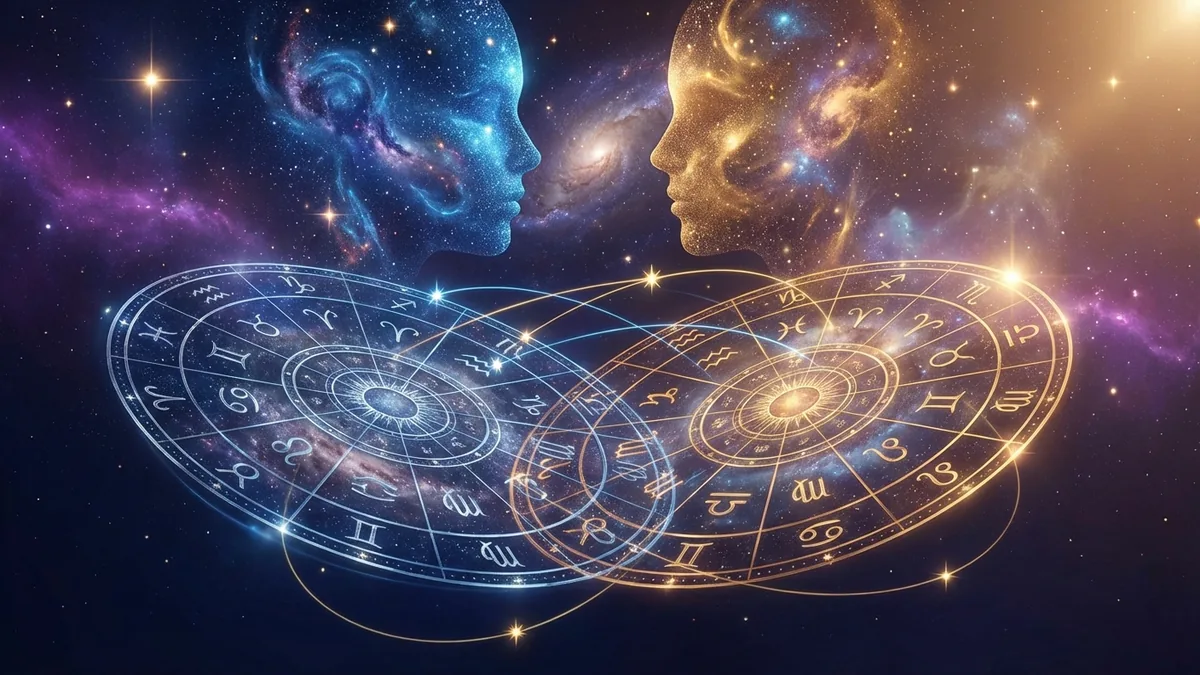
Synastry is the branch of astrology that examines relationships by comparing two birth charts side by side. The term comes from the Greek words syn (together) and astron (star), literally meaning "stars together." While popular culture often reduces relationship astrology to sun sign compatibility, synastry is far more sophisticated, analyzing how the planets, points, and angles in one person's chart interact with those in another's chart. These interactions reveal the dynamics between two people—where they harmonize, where they challenge each other, and what lessons the relationship brings.
Understanding synastry matters because relationships are rarely simple. Two people can feel an immediate attraction yet struggle with communication. Others might not experience fireworks but build something enduring and supportive. Synastry helps explain these nuances by showing which planetary energies blend easily and which create friction. This technique applies to all relationships—romantic partnerships, friendships, family bonds, and professional collaborations—though it's most commonly used for romantic connections.
The fundamental premise of synastry is that we don't experience our charts in isolation. When we interact with another person, their planetary energies activate specific parts of our chart, and ours activate theirs. This mutual activation creates a unique relational field that exists only between those two individuals. The same person might bring out your playful side in one relationship and your serious side in another, depending on how the charts interact.
How It Works
Synastry works by examining aspects—the geometric angles between planets in the two charts. When one person's Venus (planet of love and values) forms a trine (120-degree angle) to another person's Mars (planet of desire and action), this creates a natural flow between how one person loves and how the other pursues. The Venus person feels appreciated for their affection, while the Mars person finds their desires well-received. Conversely, if someone's Saturn (planet of structure and limitation) squares (90-degree angle) your Sun (core identity), they might feel critical or restrictive toward your self-expression, even without conscious intention.
Beyond aspects between planets, astrologers examine house overlays—where one person's planets fall in the other's chart houses. If your Venus lands in someone's seventh house (the relationship sector), you naturally embody partnership qualities for them. If their Mars falls in your fourth house (home and family), they might energize or agitate your domestic life. These overlays show which life areas get activated through the connection. A planet falling in someone's first house means they experience you as directly impacting their identity, while the same planet in their twelfth house might indicate a more unconscious or spiritual influence.
Certain synastry patterns carry particular weight. Conjunctions—when planets occupy the same degree—create intense merging of those energies. If your Moon (emotions and needs) conjuncts someone's Venus, emotional and romantic expressions blend seamlessly. Double whammies, where two people's planets aspect each other reciprocally (your Venus trines their Mars and their Venus trines your Mars), create mutual recognition and balanced exchange. The Moon's nodes in synastry often indicate karmic or fated connections, suggesting the relationship carries important evolutionary purpose for both people.
Composite charts and midpoint techniques extend synastry further. A composite chart mathematically calculates the midpoint between each planetary pair, creating a single chart representing the relationship itself as its own entity. This shows the relationship's inherent nature independent of either person. However, traditional synastry—the direct chart comparison—remains the foundation because it honors each person's individuality while revealing how those individualities interact.
Examples in Action
Consider a synastry between two people where Person A's Sun in Aries conjuncts Person B's Venus in Aries. Person B finds Person A's core identity (Sun) inherently attractive and lovable (Venus). Person A feels genuinely seen and appreciated by Person B. This aspect alone creates natural affinity. However, if Person A's Mars in Cancer squares Person B's Saturn in Libra, tension emerges. Person A's emotional assertiveness and protective instincts (Mars in Cancer) clash with Person B's need for measured, fair responses (Saturn in Libra). Person A might feel controlled or dampened, while Person B experiences Person A as too reactive. Both dynamics exist simultaneously—the ease of Sun-Venus and the friction of Mars-Saturn—creating the relationship's texture.
House overlays add another layer. Imagine Person A's Mercury in Gemini falls in Person B's third house. Person A naturally stimulates Person B's communication, daily interactions, and curiosity. They might introduce Person B to new ideas or become the person they most want to talk with. But if Person A's Pluto in Scorpio lands in Person B's eighth house, Person A triggers transformation around Person B's deeper psychological material, shared resources, or intimacy patterns. This placement can feel profound and revealing but also occasionally overwhelming or intrusive, depending on how Person B relates to their eighth house themes.
A real-world pattern might look like this: two business partners have Person A's Jupiter (expansion, optimism) trine Person B's Sun (identity, vitality), creating mutual encouragement and confidence. However, Person A's Uranus (disruption, independence) squares Person B's Moon (emotional security, needs). While they inspire each other professionally, Person A's unpredictability or need for freedom might unsettle Person B emotionally. Understanding this through synastry helps them appreciate the professional synergy while recognizing why they might not want to share living space or make each other their primary emotional support.