Aspects & Patterns

What Is a Grand Cross? The Most Intense Aspect Pattern

grand cross astrology grand cross meaning grand cross birth chart
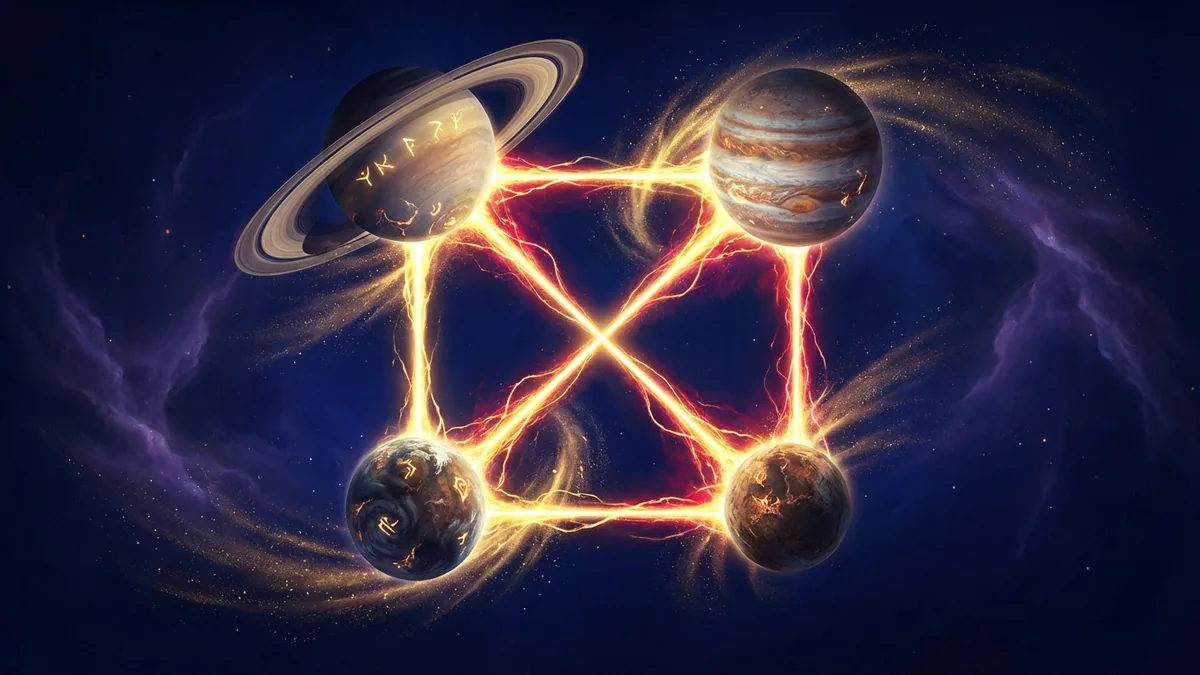
Grand Cross - astrology illustration

What Is Grand Cross?

A Grand Cross, also called a Grand Square, represents one of the most challenging yet potentially transformative configurations in astrology. This pattern occurs when four planets or points in a birth chart form four squares (90-degree angles) and two oppositions (180-degree angles), creating a cross-like formation that spans all four quadrants of the chart. The visual symmetry is striking, but the experiential reality for those born with this pattern is often one of persistent tension and the need to navigate multiple competing demands simultaneously.

The Grand Cross matters in astrology because it concentrates enormous energy within a chart while simultaneously creating built-in obstacles to its easy expression. Unlike more harmonious configurations that allow energy to flow freely, the Grand Cross creates a self-perpetuating dynamic where attempting to resolve tension in one area immediately activates challenges in another. This isn't inherently negative—many individuals with Grand Crosses become exceptionally capable problem-solvers and high achievers—but it does require conscious awareness and strategic effort.

Understanding the Grand Cross in your birth chart, or recognizing when planets transit to form one temporarily, provides crucial insight into periods of maximum pressure and maximum potential. The key lies not in eliminating the tension, which is structurally impossible, but in learning to work with it productively.

How It Works

The mechanics of a Grand Cross require four planets positioned roughly 90 degrees apart, creating what amounts to a closed circuit of challenging aspects. Each planet squares the two planets adjacent to it in the pattern and opposes the planet directly across from it. This means every planet in the configuration is under stress from two directions simultaneously. If you imagine trying to move forward while being pulled backward and pushed from both sides, you begin to understand the felt experience of this pattern.

Grand Crosses are categorized by modality—Cardinal, Fixed, or Mutable—and this distinction profoundly affects how the pattern manifests. A Cardinal Grand Cross involves planets in Aries, Cancer, Libra, and Capricorn, creating tension around initiation, leadership, and taking action. People with this configuration often feel compelled to start multiple projects or take charge in various life areas, yet find that progress in one domain creates crisis or resistance in another. A Fixed Grand Cross, spanning Taurus, Leo, Scorpio, and Aquarius, generates tension around stubbornness, values, and resistance to change. Here, the challenge involves deeply entrenched patterns and the difficulty of releasing control or shifting perspective. A Mutable Grand Cross connects Gemini, Virgo, Sagittarius, and Pisces, creating tension around adaptability, information processing, and scattered energy. This variant often produces mental restlessness and difficulty committing to a single direction.

The astrological logic behind the Grand Cross's difficulty lies in its lack of easy outlets. In other challenging patterns, there's typically at least one area of lesser resistance where energy can discharge. The Grand Cross offers no such relief valve—it's tension all the way around. However, this very quality can forge remarkable resilience and capability. The constant need to balance competing demands develops sophisticated integration skills. Many people with Grand Crosses report feeling like they're always "on," always managing multiple complex situations, but this can translate into an exceptional capacity to handle what would overwhelm others.

The element distribution within the Grand Cross also matters significantly. A Grand Cross necessarily involves four different signs, and these will always share the same modality but differ in element. This means you're dealing with fire, earth, air, and water simultaneously—instinct, practicality, intellect, and emotion all demanding attention at once. The developmental task becomes learning to honor all four dimensions of experience rather than privileging one at the expense of others. When someone with a Grand Cross achieves this integration, they often display a remarkable wholeness and ability to operate effectively across diverse contexts.

Examples in Action

Consider a Cardinal Grand Cross involving Mars in Aries, Venus in Cancer, Saturn in Libra, and Pluto in Capricorn—a configuration that actually occurred for people born in certain periods. Mars in Aries wants immediate action and self-assertion. Venus in Cancer seeks emotional security and nurturing connections. Saturn in Libra demands fair partnerships and social responsibility. Pluto in Capricorn insists on structural transformation and confronting power dynamics. Someone with this pattern might experience constant tension between personal desires (Mars in Aries), family or emotional needs (Venus in Cancer), relationship obligations (Saturn in Libra), and career or societal pressures (Pluto in Capricorn). Taking bold action at work might trigger family insecurity; prioritizing a partner's needs might feel like self-abandonment; focusing on personal goals might damage professional relationships. The gift that can emerge from working with this configuration is the capacity to make decisions that genuinely integrate all four domains rather than sacrificing one for another.

A Fixed Grand Cross presents differently. Imagine the Sun in Taurus, Moon in Leo, Neptune in Scorpio, and Jupiter in Aquarius. The Sun in Taurus wants stability, sensory pleasure, and material security. The Moon in Leo needs recognition, creative expression, and dramatic emotional validation. Neptune in Scorpio seeks deep psychological transformation and spiritual surrender. Jupiter in Aquarius pushes toward progressive ideals and intellectual freedom. This person might find their need for comfort and routine (Taurus Sun) constantly disrupted by their need for attention and excitement (Leo Moon), while their desire for emotional intensity (Scorpio Neptune) conflicts with their attraction to detached, rational principles (Aquarius Jupiter). The stubbornness of Fixed signs means these tensions don't resolve easily—each part of the self holds its ground. Yet when consciously integrated, this configuration can produce someone who maintains strong values and authentic self-expression while remaining open to profound transformation and innovative thinking.

Transiting Grand Crosses affect everyone, regardless of natal chart patterns. During periods when planets form this configuration in the sky, collective tension rises. For instance, when transiting Mars, Jupiter, Uranus, and Pluto form a Cardinal Grand Cross, global events often reflect themes of crisis, confrontation, and forced change in leadership, international relations, and social structures. Individuals experience this as pressure points in the life areas represented by the houses where these transiting planets fall in their personal charts. Someone with the Cardinal Grand Cross transiting their 1st, 4th, 7th, and 10th houses would feel intense pressure around personal identity, home and family, partnerships, and career—all simultaneously demanding attention and transformation.
Understanding grand cross is the first step. The next step is seeing how it shows up in your chart.

Get Your Free Cosmic Blueprint

Practical Tips

Working effectively with a Grand Cross requires strategic energy management rather than attempting to eliminate the inherent tension. The first practical step is identifying which planet in the configuration feels most accessible or developed. This becomes your entry point—the area where you can most easily take conscious action. From there, you can deliberately work to strengthen the opposite point in the pattern, creating a more balanced opposition rather than one side overwhelming the other. Once you've stabilized one axis of the cross, you can turn attention to the other axis. This sequential approach prevents the overwhelming feeling that you must fix everything simultaneously.

Another crucial practice involves recognizing that the Grand Cross functions like a four-way negotiation. When making significant decisions, consciously check in with all four corners of the pattern. If you have planets in Aries, Cancer, Libra, and Capricorn, for example, ask: What does my individual will want (Aries)? What do my emotional needs and family require (Cancer)? What do my relationships and sense of fairness demand (Libra)? What do my responsibilities and long-term goals necessitate (Capricorn)? Rather than letting these voices fight unconsciously, you bring them to the table deliberately. The goal isn't perfect balance in every moment—that's impossible—but rather conscious choice about which corner receives priority in specific contexts, with the understanding that you'll need to tend to the others soon.

For those without a natal Grand Cross, understanding this pattern helps during transiting Grand Crosses or when working with others who have this configuration. During transit periods, reduce overwhelm by limiting new commitments and creating extra space for processing. Recognize that the tension is temporary and serves to highlight areas requiring integration or change. When supporting someone with a natal Grand Cross, understand that their experience of life genuinely involves more simultaneous complexity than average. What looks like inability to commit or constant crisis may actually be their reality of navigating multiple legitimate demands. Patience and acknowledgment of this complexity can be profoundly supportive.

Common Misconceptions

Misconception: A Grand Cross means your life will be terrible or you're doomed to constant struggle. This fatalistic interpretation misses the entire developmental potential of the pattern. While a Grand Cross does indicate areas of sustained tension, many highly accomplished, satisfied individuals have this configuration. The tension creates motivation, and the constant need to balance competing demands develops exceptional integration and problem-solving skills. The pattern is challenging, certainly, but challenge and misery are not synonymous. Many people with Grand Crosses report that once they learn to work with the configuration, they actually appreciate the dynamic quality it brings to their lives. The key difference lies in whether the tension remains unconscious and reactive or becomes conscious and purposefully directed.

Misconception: You should try to break or eliminate the Grand Cross pattern. Some approaches suggest "resolving" the Grand Cross through specific transits or progressions, but this misunderstands the nature of natal configurations. The Grand Cross is a permanent structural feature of your chart, representing core psychological dynamics that persist throughout life. The goal isn't elimination but rather increasingly sophisticated integration. Attempting to "fix" or "break" the pattern often leads to frustration because the configuration will continue reasserting itself. Instead, the mature approach involves accepting the pattern as a fundamental part of your psychological makeup and learning to work with rather than against its inherent dynamics. Think of it as learning to navigate a four-way intersection skillfully rather than trying to turn it into a straight road.

Misconception: All Grand Crosses are equally intense and function identically. The modality (Cardinal, Fixed, or Mutable) profoundly affects how a Grand Cross operates, as do the specific planets involved. A Grand Cross involving the Moon, Venus, Mars, and Jupiter will feel quite different from one involving Saturn, Uranus, Neptune, and Pluto. The former brings emotional and relational challenges that, while difficult, are more immediately accessible to consciousness. The latter involves generational outer planets and creates tensions that may operate at a more collective or unconscious level. Additionally, aspects from other planets to the Grand Cross, the houses involved, and the overall chart context all modify how the pattern expresses itself. Two people with Grand Crosses in the same modality may have remarkably different experiences based on these additional factors.

Key Takeaways

If you have a Grand Cross in your birth chart, recognize it as a signature of someone built for complexity. You're not designed for a simple, linear life, and trying to force yourself into that mold will only create additional frustration. Your path involves learning to hold multiple truths simultaneously, to honor competing needs without letting any single perspective dominate completely. This is sophisticated psychological work, and it's worth approaching with patience and self-compassion. The periods when the Grand Cross feels most activated are often times of significant growth, even when they're uncomfortable. Trust that your capacity to navigate complexity is developing, even when it doesn't feel that way in the moment.

For everyone, understanding the Grand Cross—whether in your own chart or as a transiting pattern—deepens your appreciation for how astrology describes the architecture of experience. These geometric patterns aren't arbitrary; they reflect genuine psychological and energetic dynamics that shape how we encounter life. The Grand Cross, with its perfect symmetry and built-in tension, reminds us that some of life's most valuable qualities—resilience, integration, sophisticated decision-making—develop not despite challenges but through them. Whether you're working with this pattern personally or simply recognizing it in the larger astrological weather, approaching it with understanding rather than fear transforms it from an obstacle into a teacher.

Frequently Asked Questions

A Grand Cross is a rare aspect pattern formed when four planets are positioned roughly 90 degrees apart, creating a square formation in your birth chart. These four planets also form two opposition aspects (180 degrees) that cross through the center of the chart. The Grand Cross creates significant tension and challenge, but also tremendous potential for growth and achievement when you learn to balance these conflicting energies.

A Grand Cross in your birth chart typically creates a personality that feels pulled in multiple directions simultaneously, often leading to internal conflict and external challenges. People with this pattern tend to be highly motivated, resilient, and capable of handling complex situations because they're constantly navigating competing demands. While it can feel overwhelming at times, this aspect pattern often produces individuals who are exceptionally strong, accomplished, and able to see multiple perspectives on any issue.

The Grand Cross is considered challenging because it combines the most tense aspects in astrology: squares and oppositions working simultaneously. This creates constant friction between four different areas of your life, making it difficult to find balance or rest. However, this ongoing tension also builds character, strength, and problem-solving abilities that many people without this pattern never develop.

No, having a Grand Cross does not mean bad luck, though it does indicate a more challenging life path with significant obstacles to overcome. Many successful and accomplished people have Grand Crosses in their birth charts because the constant pressure motivates them to achieve and develop exceptional coping skills. The key is learning to work with the pattern constructively rather than letting the tension overwhelm you.

There are three types of Grand Crosses based on which modalities (qualities) are involved: Cardinal, Fixed, and Mutable. A Cardinal Grand Cross creates tension around initiation and leadership, pushing you to take action in multiple directions. A Fixed Grand Cross generates stubborn resistance to change and power struggles over control. A Mutable Grand Cross produces scattered energy, adaptability challenges, and difficulty maintaining focus or boundaries.

Your Weekly Cosmic Playbook

Every Sunday: personalized transit forecast, power days, and practical guidance for the week ahead.

Free every Sunday. Unsubscribe anytime.

Welcome to Your Cosmic Playbook!

Your personalized weekly forecast arrives every Sunday at 6 PM in your timezone.

Don't see it? Check your spam folder and add us to contacts!

CosmicGuide AI

Reviewed by CosmicGuide AI Astrologers

Forecasts are reviewed by professional astrologers with 15+ years of experience in natal and predictive astrology.

About our editorial process

More in Aspects & Patterns

Related Concepts