Houses & Angles

The 12 Houses in Astrology: Complete Guide to Life Areas

12 houses astrology astrological houses houses meaning birth chart houses
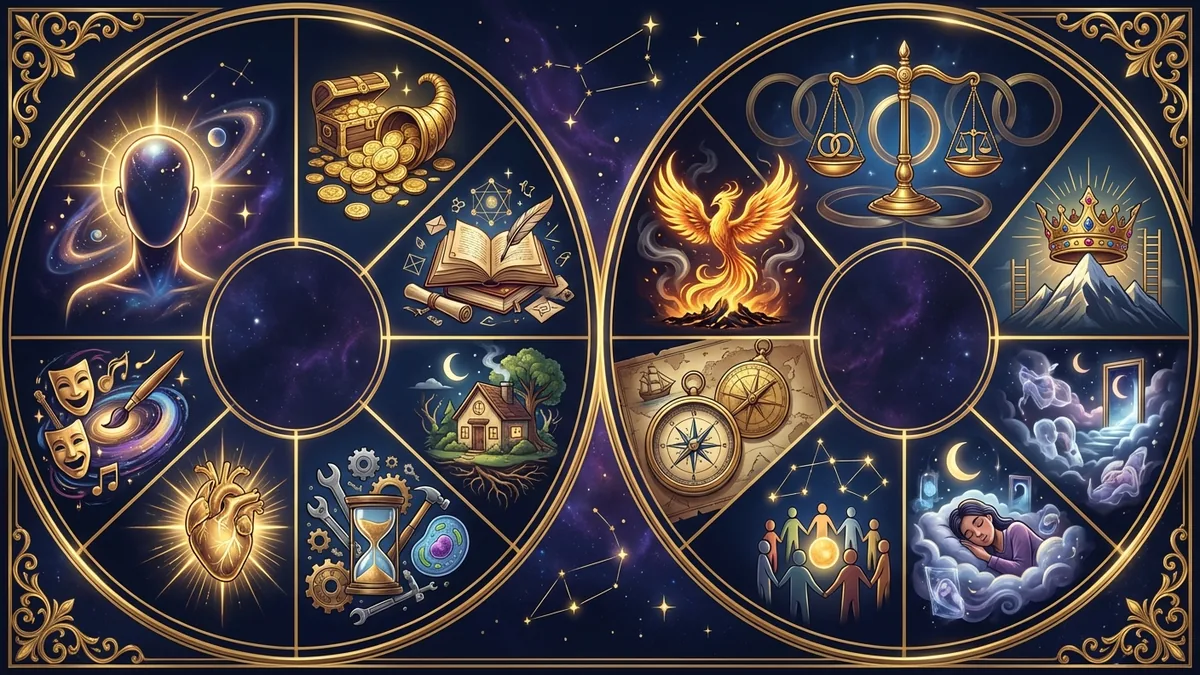
The 12 Houses - astrology illustration

What Is The 12 Houses?

If the zodiac signs represent the actors in your life story and the planets are the characters themselves, then the twelve houses are the stages where all the action unfolds. The twelve houses form the structural framework of your birth chart, dividing the 360-degree circle around Earth into twelve distinct sectors, each governing specific life areas—from your identity and possessions to your relationships, career, and spiritual pursuits. Unlike the signs, which remain relatively consistent for everyone born in the same month, the houses are determined by the exact time and location of your birth, making them deeply personal and unique to you.

Understanding the houses transforms astrology from a system of personality traits into a practical map of lived experience. While your Sun sign might describe your core identity, it's the house that Sun occupies that tells you where that identity seeks expression. A Leo Sun in the tenth house will express their creativity through career and public recognition quite differently than a Leo Sun in the fourth house, who channels that same energy into home and family life. The houses answer the question: where does this planetary energy manifest in my actual life?

The house system creates a snapshot of the sky at the moment of your birth from your specific vantage point on Earth. As our planet rotates, different signs rise on the eastern horizon throughout the day, changing which sign occupies which house approximately every two hours. This is why knowing your birth time is crucial for an accurate chart—even siblings born on the same day can have dramatically different house placements if born hours apart, leading to vastly different life experiences despite sharing similar planetary positions.

How It Works

The twelve houses follow a natural sequence that mirrors the human journey from birth to transcendence. They're traditionally divided into four groups of three, known as angular, succedent, and cadent houses. The angular houses (1st, 4th, 7th, and 10th) mark the cardinal points of the chart and represent action, initiation, and the most dynamic areas of life. The succedent houses (2nd, 5th, 8th, and 11th) follow the angles and deal with consolidation, resources, and what we build or maintain. The cadent houses (3rd, 6th, 9th, and 12th) prepare us for transition, governing learning, adaptation, and the mental processing of experience.

Each house also corresponds to one of the zodiac signs in their natural order, creating what's called natural rulership. The first house naturally corresponds to Aries and is associated with Mars, the second with Taurus and Venus, and so forth. This doesn't mean your first house will contain Aries—in fact, it likely won't—but it does mean the first house shares thematic similarities with Aries energy: self, identity, initiation, and appearance. This natural zodiac creates a baseline meaning for each house that remains constant regardless of which signs actually occupy them in your personal chart.

The beginning of each house is called a cusp, and the most important cusp is the Ascendant, which marks the beginning of the first house and the eastern horizon at your birth moment. The Ascendant, along with the Midheaven (the cusp of the tenth house), forms the primary angles of your chart and has enormous influence over your life direction. Planets positioned near these angles, especially within about ten degrees, gain extra strength and prominence in how they express themselves in your life. A planet on an angle becomes a defining feature of your personality and life path.

The houses operate on a principle called derived houses, meaning you can use any house as a starting point to understand a specific area of life in greater depth. For example, the seventh house represents your spouse or partner, so the eighth house (second from the seventh) represents your partner's money or resources. The tenth house represents your career, so the eleventh house (second from the tenth) represents the income from that career. This technique allows astrologers to answer highly specific questions by rotating the chart to make any house temporarily function as the first house of that matter.

Examples in Action

Consider someone born with their Sun in the second house in Cancer. The Sun represents core identity and life purpose, the second house governs money, possessions, and values, and Cancer brings emotional sensitivity and nurturing qualities. This person likely defines themselves through what they own or earn, finding security in material stability. They might pursue careers in finance, real estate, or resource management, but with Cancer's influence, they'd approach these areas with emotional intelligence—perhaps as a financial advisor who truly cares about clients' security, or someone who creates beautiful, emotionally meaningful products. Their self-worth is intimately tied to financial stability, and they need to learn that their value exists independently of their bank account.

Now contrast this with someone who has Mars in the seventh house in Aquarius. Mars represents drive, assertion, and sometimes conflict, while the seventh house governs partnerships, marriage, and open enemies. Aquarius brings independence, innovation, and sometimes emotional detachment. This placement suggests someone who is energized by partnerships but may also experience conflict within them. They're attracted to unconventional partners or relationship structures, and they assert their independence strongly within committed relationships. They might unconsciously pick fights to maintain autonomy or attract partners who are assertive themselves. The key growth area involves learning to balance their need for independence with genuine intimacy, and channeling Mars' competitive energy into collaborative achievement rather than relationship power struggles.

A more complex example: imagine someone with a stellium—multiple planets clustered together—in the twelfth house. Let's say they have Mercury, Venus, and Jupiter all in the twelfth house in Pisces. The twelfth house represents the unconscious, hidden matters, spirituality, and self-undoing. This person's communication style (Mercury), relationship patterns (Venus), and growth opportunities (Jupiter) all operate largely beneath conscious awareness. They might be deeply intuitive, artistically gifted, and spiritually inclined, but struggle to articulate their needs or make themselves visible in relationships. They could excel in behind-the-scenes work, healing professions, or artistic pursuits that channel the unconscious. The challenge is bringing these planets into conscious expression rather than letting them remain in the shadows, where they might manifest as self-sabotage or escapism.

Understanding the 12 houses is the first step. The next step is seeing how it shows up in your chart.

Get Your Free Cosmic Blueprint

Practical Tips

Begin working with houses by identifying which houses contain planets in your chart and which stand empty. Contrary to popular belief, empty houses aren't problematic—they simply indicate areas of life that may require less conscious attention or unfold more naturally. The sign on an empty house's cusp and the location of that sign's ruling planet will still tell you about that life area. For instance, if your fifth house of creativity and children is empty but has Sagittarius on the cusp, look to Jupiter (Sagittarius' ruler) to understand how and where creative and romantic matters will manifest. If Jupiter sits in your tenth house, creative expression might come through your career or public life.

Pay special attention to planets in angular houses (1st, 4th, 7th, 10th), as these will be the most active and visible forces in your life. These planets don't just influence you internally—they shape how you interact with the world and how the world responds to you. A Saturn in the tenth house will be far more noticeable in your life experience than a Saturn in the twelfth house, manifesting as tangible career challenges, public responsibilities, or authority issues that demand conscious navigation. Track transiting planets as they move through your houses to understand which life areas are being activated at any given time. When Jupiter transits your second house, for example, it's often a favorable period for increasing income or acquiring meaningful possessions.

When interpreting houses, always synthesize three factors: the sign on the house cusp, any planets within the house, and the condition of the house's ruling planet. If you have Gemini on your seventh house cusp but no planets inside, you'd look to Mercury's placement to understand partnership dynamics. If Mercury sits in your third house, communication and mental connection become the foundation of your relationships. You might attract partners who are siblings, neighbors, or people you meet in your local environment, and the quality of daily communication will make or break your partnerships. This layered approach prevents superficial readings and reveals the intricate connections within your chart.

Common Misconceptions

Misconception: Empty houses mean nothing happens in those life areas. This is perhaps the most common house-related anxiety among beginners. Empty houses simply indicate that you don't have natal planets focusing energy there, but these life areas still exist and function. The sign on the cusp and its ruling planet's condition describe how those areas unfold. Additionally, transiting planets will move through empty houses throughout your life, activating them temporarily. Someone with an empty seventh house still has relationships—they simply may not be the primary vehicle for growth and challenge in the way they would be with, say, Saturn or Pluto positioned there.

Misconception: The house system you use doesn't matter. Actually, astrologers use different house systems (Placidus, Whole Sign, Equal House, Koch, and others), and they can place planets in different houses. Placidus, the most common in Western astrology, uses complex calculations based on the Earth's rotation and can create unequal house sizes, especially at extreme latitudes. Whole Sign houses assign one complete sign to each house, making each exactly 30 degrees. While the Ascendant and Midheaven remain constant, planets near house cusps might shift houses between systems. Most astrologers develop a preference through practice, and both systems can provide accurate insights—what matters is consistency and understanding the logic of your chosen system.

Misconception: House meanings are fixed and simple. While each house has core significations, they're far more nuanced than cookbook definitions suggest. The sixth house isn't just about health and daily work—it's about the process of perfecting skills, the relationship between body and routine, service versus servitude, and how we maintain our lives. The eighth house isn't only about death and sex—it's fundamentally about merging resources, psychological transformation, what we inherit (materially and psychologically), and how we navigate power in intimate bonds. Understanding houses requires moving beyond keywords to grasp the underlying principles that unify each house's seemingly diverse meanings.

Key Takeaways

The houses ground astrology in the concrete reality of your daily life, transforming abstract planetary energies into specific, observable experiences. Rather than overwhelming yourself by trying to memorize all twelve house meanings at once, start with the houses that contain your Sun, Moon, and Ascendant ruler, as these will be most immediately relevant to your conscious experience. Notice which life areas naturally command your attention and energy—chances are, you have significant planetary placements in those houses. The beauty of the house system is that it validates your unique experience rather than forcing you into generic descriptions.

As you deepen your understanding of houses, you'll discover that they reveal not just what happens in your life, but why certain areas consistently demand your attention while others flow effortlessly. This awareness doesn't eliminate challenges, but it provides context and meaning for them. Someone with a loaded eighth house will face repeated invitations to transform through crisis and intimacy—not as punishment, but as their soul's chosen path toward depth and empowerment. The houses show you where you're meant to develop mastery, and recognizing this can shift struggle into purposeful growth. Your birth chart, with its unique house placements, isn't a life sentence but a map highlighting where your consciousness is meant to expand.

Frequently Asked Questions

The 12 houses are divisions of the sky in your birth chart that represent different life areas and experiences. Each house governs specific topics like relationships, career, home life, and personal identity. The houses are numbered 1 through 12, starting from the eastern horizon and moving counterclockwise around the chart. Where planets fall in your houses shows which life areas receive the most energy and focus.

Houses are calculated based on your exact birth time and location, which determines how the zodiac signs align with each house. The Ascendant, or rising sign, marks the beginning of the first house and rotates the entire house system. Each house spans roughly 30 degrees of the 360-degree chart, though some house systems create unequal divisions. Planets located within a house influence that specific life area with their unique energy.

Your birth time determines the exact position of the houses in your chart because the houses rotate completely every 24 hours. Without an accurate birth time, astrologers cannot calculate your Ascendant or house placements correctly. Even a difference of four minutes can change your rising sign, which shifts all 12 houses. This is why people born on the same day can have completely different house configurations and life experiences.

Each house governs distinct life themes: the 1st house rules self and identity, the 2nd rules money and values, the 3rd rules communication, the 4th rules home and family, the 5th rules creativity and romance, and the 6th rules health and daily work. The 7th house governs partnerships, the 8th rules transformation and shared resources, the 9th rules travel and philosophy, the 10th rules career and public image, the 11th rules friendships and goals, and the 12th rules spirituality and the subconscious. Understanding which planets occupy which houses reveals where you'll experience the most growth and challenges.

No, empty houses do not indicate lack or problems in those life areas. Most people have empty houses because there are only 10 planets but 12 houses in a birth chart. Empty houses simply mean those areas may require less focused attention or develop more naturally without major challenges. The sign on the house cusp and its ruling planet still provide information about how you approach that life area.

Your Weekly Cosmic Playbook

Every Sunday: personalized transit forecast, power days, and practical guidance for the week ahead.

Free every Sunday. Unsubscribe anytime.

Welcome to Your Cosmic Playbook!

Your personalized weekly forecast arrives every Sunday at 6 PM in your timezone.

Don't see it? Check your spam folder and add us to contacts!

CosmicGuide AI

Reviewed by CosmicGuide AI Astrologers

Forecasts are reviewed by professional astrologers with 15+ years of experience in natal and predictive astrology.

About our editorial process

More in Houses & Angles

Related Concepts