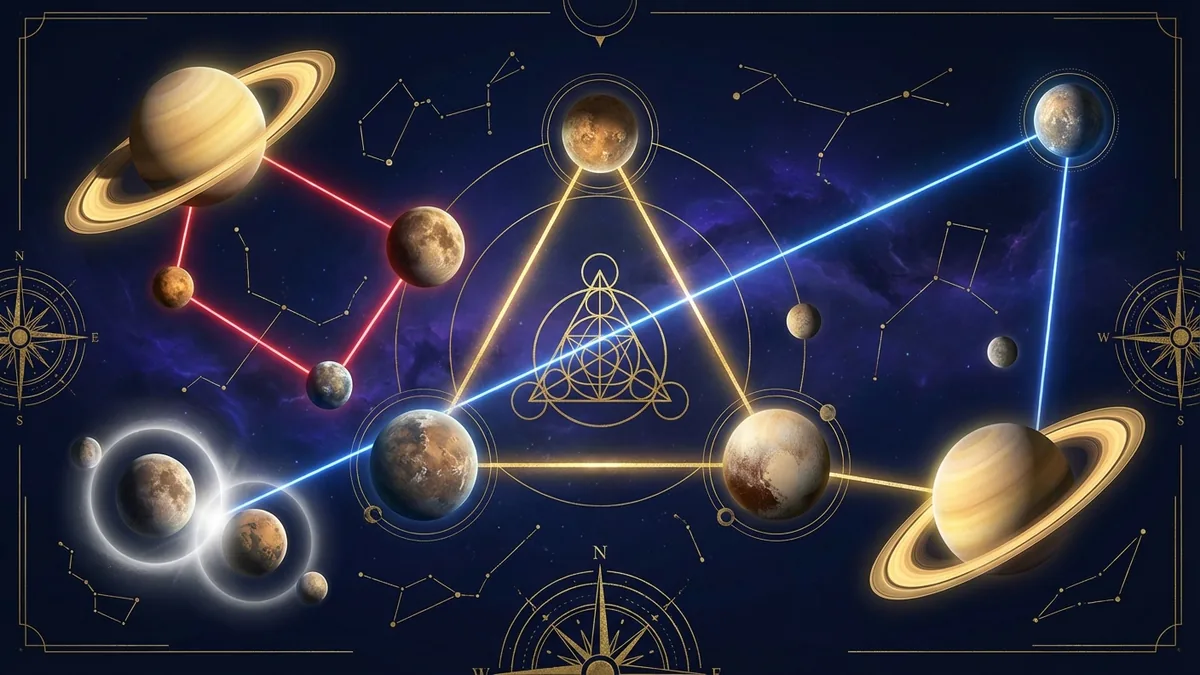
What Is Planetary Aspects?
Planetary aspects are the angular relationships between planets in an astrological chart, and they form the language through which celestial bodies communicate with one another. When two planets are separated by specific degrees—whether 60, 90, 120, or 180 degrees—they form geometric patterns that astrologers have observed to correlate with distinct psychological dynamics and life experiences. These aspects reveal how different parts of your personality interact: whether they support each other, create friction, or demand integration.
Understanding aspects transforms astrology from a simple catalog of planetary placements into a dynamic system of interconnected energies. A person with Mars in Aries and Venus in Leo doesn't just have two separate planetary positions—the relationship between those planets tells us how their assertiveness and affection work together or clash. Aspects are what make a birth chart come alive, showing the internal dialogues, tensions, and harmonies that shape how we experience ourselves and move through the world.
Aspects matter because they explain why people with the same Sun sign can be remarkably different. The Sun's aspects to other planets color how that solar energy expresses itself. A Sun conjunct Saturn person will experience their core identity quite differently from someone with Sun trine Jupiter, even if both have the Sun in Gemini. Aspects are the grammar of astrological interpretation—the structure that gives meaning to individual planetary words.
How It Works
Aspects are calculated by measuring the distance in degrees between two planets along the ecliptic, the apparent path of the Sun through the zodiac. The zodiac wheel contains 360 degrees, and certain angular relationships have been recognized across astrological traditions as particularly significant. These major aspects divide the circle into whole fractions: the opposition (180 degrees) divides it in half, the trine (120 degrees) into thirds, the square (90 degrees) into quarters, and the sextile (60 degrees) into sixths. The conjunction (0 degrees) represents planets occupying the same space, blending their energies at the source.
Each aspect carries a distinct quality based on its geometric nature and the elemental relationships it creates. Hard aspects—squares and oppositions—connect planets in signs of incompatible elements (fire and water, earth and air), generating tension that demands action and integration. These aspects often correlate with challenges, internal conflicts, or external obstacles that catalyze growth through friction. Soft aspects—trines and sextiles—connect planets in compatible elements (fire with fire or air, earth with earth or water), facilitating easy energy flow and natural talents. The conjunction is neutral in quality, intensifying and fusing planetary energies for better or worse, depending on the planets involved.
Astrologers use orbs to determine whether an aspect is active—that is, how many degrees of separation still count as forming the aspect. A Mars-Saturn square at exactly 90 degrees is precise, but most astrologers would still recognize the square if Mars were at 5 degrees Aries and Saturn at 10 degrees Cancer (an 85-degree separation). Typical orbs range from 6 to 10 degrees for major aspects, though tighter orbs produce stronger effects. The applying versus separating distinction also matters: an aspect that is moving toward exactness (applying) tends to feel more intense and future-oriented than one that has already perfected and is separating.
The astrological logic behind aspects draws from both geometric harmony and observed correlation. Pythagorean philosophy held that certain mathematical ratios produced consonance or dissonance in music, and astrology extends this principle to planetary relationships. The trine's division of the circle into three equal parts reflects a natural flow, while the square's division into four creates a cross—a symbol of tension and crucifixion in many traditions. Beyond theory, astrologers have noted consistent patterns: people with Venus-Saturn squares often experience relationship challenges that teach them about commitment, while those with Mercury-Jupiter trines frequently possess natural teaching or communication abilities.
Examples in Action
Consider someone born with the Sun in Taurus at 15 degrees and Pluto in Scorpio at 17 degrees—a Sun-Pluto opposition with a 2-degree orb. This person experiences their core identity (Sun) in direct tension with transformative, intense psychological forces (Pluto). They may feel pulled between the desire for Taurean stability and security versus Plutonian compulsions toward crisis, catharsis, and deep change. This aspect often manifests as power struggles in relationships, an intense personality that affects others strongly, or a life marked by significant transformations that reshape their sense of self. The opposition creates awareness through polarization—they can see both the need for stability and the necessity of transformation, even as these needs seem to conflict.
In contrast, someone with Mercury in Gemini at 10 degrees trine Neptune in Aquarius at 12 degrees experiences an easy flow between rational thinking and imaginative, intuitive perception. This aspect might manifest as natural storytelling ability, an aptitude for poetry or music, or the capacity to communicate spiritual or abstract concepts in accessible ways. The trine doesn't guarantee success or effort—it simply means these energies work together without friction. This person might take their creative communication gifts for granted precisely because they come so naturally, while someone with a Mercury-Neptune square would struggle more with clarity but might develop stronger discernment through that struggle.
A concrete example from recent years: during the Saturn-Uranus square that was exact in 2021, many people experienced the tension between structure and freedom, tradition and innovation. Saturn in Aquarius represented the need for new social structures and collective responsibility, while Uranus in Taurus pushed for radical changes in resources, values, and physical security. This square manifested globally in conflicts between institutional control and individual liberty, between economic stability and disruptive change. In individual charts, where this square activated personal planets, people faced decisions requiring them to balance security with necessary change, to build new structures rather than cling to old ones or rebel without direction.