Astrology Basics

Cardinal, Fixed & Mutable Signs: Modalities in Astrology

modalities astrology cardinal signs fixed signs mutable signs
Modalities - astrology illustration

What Is Modalities?

When astrologers look at a birth chart, they're not just seeing twelve random signs scattered around a wheel. The zodiac operates according to underlying organizational principles, and one of the most fundamental is the system of modalities. Also called qualities or quadruplicities, modalities divide the twelve zodiac signs into three groups of four, each representing a distinct approach to energy, action, and change.

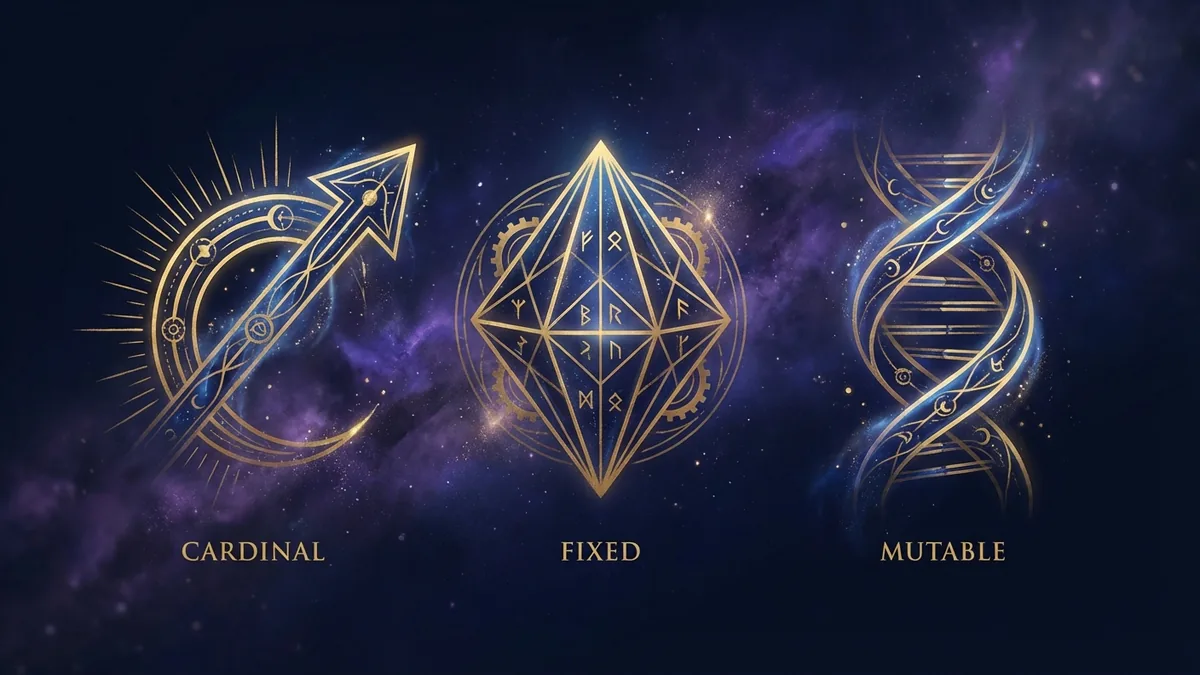
The three modalities in astrology are cardinal, fixed, and mutable. Each modality describes how a sign initiates, sustains, or transforms energy. Cardinal signs start things, fixed signs maintain them, and mutable signs adapt and transition them. Understanding modalities gives you a framework for recognizing patterns in how different signs operate, why certain signs naturally work well together, and why others create productive tension. This isn't about stereotyping—it's about understanding the fundamental rhythm each sign follows.

Modalities matter because they reveal the underlying tempo of a chart. Someone with many cardinal placements moves through life differently than someone dominated by fixed or mutable energy. When you understand modalities, you begin to see why certain people are natural initiators while others excel at follow-through or flexibility. This knowledge applies whether you're examining your own chart, understanding relationship dynamics, or timing important decisions.

How It Works

The modality system derives from the relationship between the zodiac and the seasonal year. Each modality corresponds to a specific phase in the quarterly cycle of seasons. Cardinal signs—Aries, Cancer, Libra, and Capricorn—mark the beginning of each season: spring equinox, summer solstice, autumn equinox, and winter solstice respectively. These are turning points, moments when the solar year shifts direction. Cardinal energy is initiating, direct, and action-oriented. These signs see what needs to happen and move to make it happen, often with a clear sense of direction and purpose.

Fixed signs—Taurus, Leo, Scorpio, and Aquarius—occupy the middle of each season, when that season's qualities are most established and stable. This is when spring is fully spring, summer is unmistakably summer. Fixed energy consolidates, maintains, and deepens what cardinal energy started. These signs bring staying power, concentration, and resistance to change. Where cardinal signs start the project, fixed signs build it into something lasting. They provide the determination and focus required to see things through, though this can manifest as stubbornness when circumstances demand flexibility.

Mutable signs—Gemini, Virgo, Sagittarius, and Pisces—appear at the end of each season, when change is imminent and the next season approaches. These transitional periods require adaptability and preparation for what comes next. Mutable energy is flexible, versatile, and responsive to changing conditions. These signs excel at adjustment, integration, and processing information or experiences. They can see multiple perspectives and shift approach as needed, though this adaptability can sometimes appear as inconsistency or difficulty with commitment.

The modality of a sign influences how that sign's element expresses itself. Fire, earth, air, and water each appear once in every modality, creating twelve distinct combinations. Cardinal fire (Aries) initiates action differently than mutable fire (Sagittarius) adapts and explores. Fixed earth (Taurus) maintains material stability differently than cardinal earth (Capricorn) builds structures. Understanding both element and modality together gives you a more nuanced picture of how each sign operates in practice.

Examples in Action

Consider how the modalities play out in career approaches. Someone with their Sun in Capricorn (cardinal earth) might be the person who identifies a gap in their industry and launches a company to fill it. They see the need, create the structure, and get things moving. Their colleague with Sun in Taurus (fixed earth) excels at building systems, maintaining quality standards, and ensuring the day-to-day operations run smoothly year after year. Meanwhile, their partner with Sun in Virgo (mutable earth) thrives in roles requiring adaptation—managing changing client needs, refining processes, troubleshooting problems as they arise. All three work with earth's practical, material focus, but through completely different operational styles.

Relationship dynamics often reflect modality patterns. Cardinal-cardinal partnerships can struggle with competing leadership styles—two people who both want to initiate and direct may clash over whose vision to follow. A Mars in Aries person and a Mars in Libra person might both want to take charge, just in different arenas. Fixed-fixed combinations create stability but can become stuck, neither partner willing to budge when change is necessary. Two people with Venus in fixed signs might build a deeply loyal bond but struggle when life demands they adapt their relationship structure. Mutable-mutable pairs enjoy flexibility but may lack direction, both adapting to each other until neither knows what they actually want.

In a birth chart with strong cardinal emphasis—say, Sun in Aries, Moon in Cancer, and Mars in Capricorn—you'd expect someone who constantly initiates new projects, takes leadership naturally, and feels restless without forward momentum. They might start many things but struggle with completion. Contrast this with a chart heavy in fixed placements: Sun in Taurus, Moon in Leo, Venus in Scorpio. This person brings remarkable persistence and depth but may resist necessary changes, staying too long in situations that no longer serve them. A predominantly mutable chart—Sun in Gemini, Moon in Pisces, Mercury in Virgo—suggests someone highly adaptable and perceptive but potentially scattered, responsive to so many inputs that maintaining consistent direction becomes challenging.

Understanding modalities is the first step. The next step is seeing how it shows up in your chart.

Get Your Free Cosmic Blueprint

Practical Tips

To work effectively with modalities, start by identifying which modality dominates your chart. Count your personal planets (Sun, Moon, Mercury, Venus, Mars) and your Ascendant. If most fall in cardinal signs, you're likely someone who needs to initiate and lead but might benefit from building better follow-through. Seek out fixed-sign people or activities that help you sustain what you start. If fixed energy dominates, you have natural staying power but may need to consciously cultivate flexibility. Deliberately expose yourself to new perspectives and practice adapting when circumstances shift. With mutable dominance, your adaptability is an asset, but you'll benefit from creating structure—fixed routines, cardinal goal-setting—to channel your versatility productively.

When timing activities, consider the modality of the current lunar phase or transiting planets. Cardinal ingresses—when the Sun enters Aries, Cancer, Libra, or Capricorn—mark natural times for new beginnings and initiative. These are the equinoxes and solstices, powerful moments for starting projects aligned with the season's energy. When major planets transit through fixed signs, focus on deepening, stabilizing, and maintaining what you've built. These periods favor commitment and concentration. Mutable transits are ideal for learning, adjusting plans, gathering information, and preparing for upcoming changes. Working with rather than against these rhythms makes your efforts more effective.

In relationships and teamwork, awareness of modality differences prevents misunderstanding. If you're cardinal and your partner is fixed, recognize that you're not being held back—you're being given the stability to actually complete what you envision. If you're fixed and working with mutable colleagues, their flexibility isn't flakiness—it's a necessary counterbalance to your tendency toward rigidity. Cardinal people benefit from fixed and mutable collaborators who can sustain and refine their initiatives. The most effective teams often balance all three modalities, combining initiation, maintenance, and adaptation.

Common Misconceptions

A common misconception is that cardinal signs are inherently more powerful or important than fixed or mutable signs. This misunderstanding likely stems from the association of cardinal with leadership and beginnings, which our culture often values above other contributions. In reality, each modality is equally essential. Starting something means nothing without the fixed energy to build it into reality and the mutable energy to adapt it to changing circumstances. A chart dominated by any single modality faces challenges; balance or conscious compensation is what creates effectiveness.

Another myth is that your modality determines whether you're a starter, finisher, or somewhere in between in some fixed, unchangeable way. While your natal chart's modality emphasis reveals natural tendencies, you contain all twelve signs somewhere in your chart. You have access to all three modalities through different planetary placements and houses. Additionally, transits constantly activate different modalities, giving you opportunities to develop less-emphasized qualities. Someone with a heavily mutable chart can learn to harness cardinal initiative through their Mars placement or by working consciously with cardinal transits. Your natal patterns are starting points, not limitations.

Some people believe that certain modality combinations are incompatible—that cardinal and fixed signs can't work together, or that mutable signs are somehow weaker or less committed. This reflects a misunderstanding of how modalities interact. Yes, different modalities create tension, but productive tension drives growth and balance. Cardinal signs need fixed signs to give their initiatives staying power. Fixed signs need mutable signs to prevent stagnation. Mutable signs need cardinal signs to provide direction. These aren't conflicts to avoid but complementary energies to integrate. The squares in the zodiac (signs of the same modality) actually share an operational rhythm even when their elemental approaches differ, creating a complex dynamic that's challenging but not inherently problematic.

Key Takeaways

Understanding modalities gives you a practical framework for working with your natural rhythms rather than against them. If you're predominantly cardinal, honor your need to initiate while building systems that support completion. If you're mostly fixed, respect your need for depth and stability while staying open to necessary evolution. If you're primarily mutable, value your adaptability while creating enough structure to channel it effectively. The goal isn't to change your fundamental nature but to recognize it clearly and compensate for its blind spots.

As you develop your astrological literacy, pay attention to how modalities manifest in your life and the lives of people around you. Notice when you're operating from cardinal impulse, fixed determination, or mutable adjustment. Recognize these patterns in others and respond with understanding rather than judgment. Someone's resistance to your brilliant new idea might be fixed energy needing more time to process, not obstinacy. Someone's constant adjustments might be mutable sensitivity to nuance, not lack of commitment. This awareness transforms how you navigate relationships, work, and your own internal landscape. Modalities are one of astrology's most practical tools—use them to understand the rhythm of energy in your chart and in the world around you.

Frequently Asked Questions

Modalities are one of the three main classification systems in astrology that describe how zodiac signs express their energy and approach life. The three modalities are cardinal, fixed, and mutable, with four signs belonging to each group. Modalities reveal whether a sign initiates action, maintains stability, or adapts to change. Understanding your sign's modality helps explain your natural responses to situations and challenges.

Cardinal signs (Aries, Cancer, Libra, Capricorn) are the initiators who start new projects and seasons with leadership energy. Fixed signs (Taurus, Leo, Scorpio, Aquarius) are the stabilizers who maintain momentum, resist change, and see things through with determination. Mutable signs (Gemini, Virgo, Sagittarius, Pisces) are the adapters who embrace flexibility, transition easily, and help complete cycles. Each modality plays a distinct role in how signs interact with the world.

The zodiac is organized so that each modality contains one sign from each of the four elements (fire, earth, air, water), creating a balanced system of twelve signs. This means cardinal, fixed, and mutable modalities each have exactly four signs representing different elemental expressions. This structure ensures that every combination of element and modality exists, providing diverse archetypal energies throughout the zodiac wheel.

Mutable signs are adaptable and see multiple perspectives, which can sometimes appear as indecisiveness, but this flexibility is actually a strength. Their ability to adjust, pivot, and consider various options makes them excellent problem-solvers and mediators. Rather than being truly indecisive, mutable signs simply take longer to commit because they're thoroughly exploring possibilities. This quality helps them navigate change and uncertainty better than cardinal or fixed signs.

Having multiple planets in one modality creates a dominant energy pattern in your birth chart that influences your overall approach to life. If most planets are cardinal, you're naturally driven to lead and start things; if fixed, you value stability and persistence; if mutable, you thrive on flexibility and change. This concentration can be both a strength and a challenge, as you may overuse that modality's qualities while lacking balance from the others. Understanding this pattern helps you recognize when to consciously engage the other modalities for better life balance.

Your Weekly Cosmic Playbook

Every Sunday: personalized transit forecast, power days, and practical guidance for the week ahead.

Free every Sunday. Unsubscribe anytime.

Welcome to Your Cosmic Playbook!

Your personalized weekly forecast arrives every Sunday at 6 PM in your timezone.

Don't see it? Check your spam folder and add us to contacts!

CosmicGuide AI

Reviewed by CosmicGuide AI Astrologers

Forecasts are reviewed by professional astrologers with 15+ years of experience in natal and predictive astrology.

About our editorial process

More in Astrology Basics

Related Concepts