What Is Lunar Nodes?
The lunar nodes represent one of astrology's most compelling concepts: the intersection points where the Moon's orbital path crosses the ecliptic, the apparent path of the Sun around Earth. Unlike planets or asteroids, the nodes aren't physical celestial bodies you could photograph through a telescope. They're mathematical points, coordinates in space where two great circles meet. Yet these invisible points carry profound significance in astrological interpretation, particularly in understanding life direction, soul growth, and the tension between comfort and evolution.
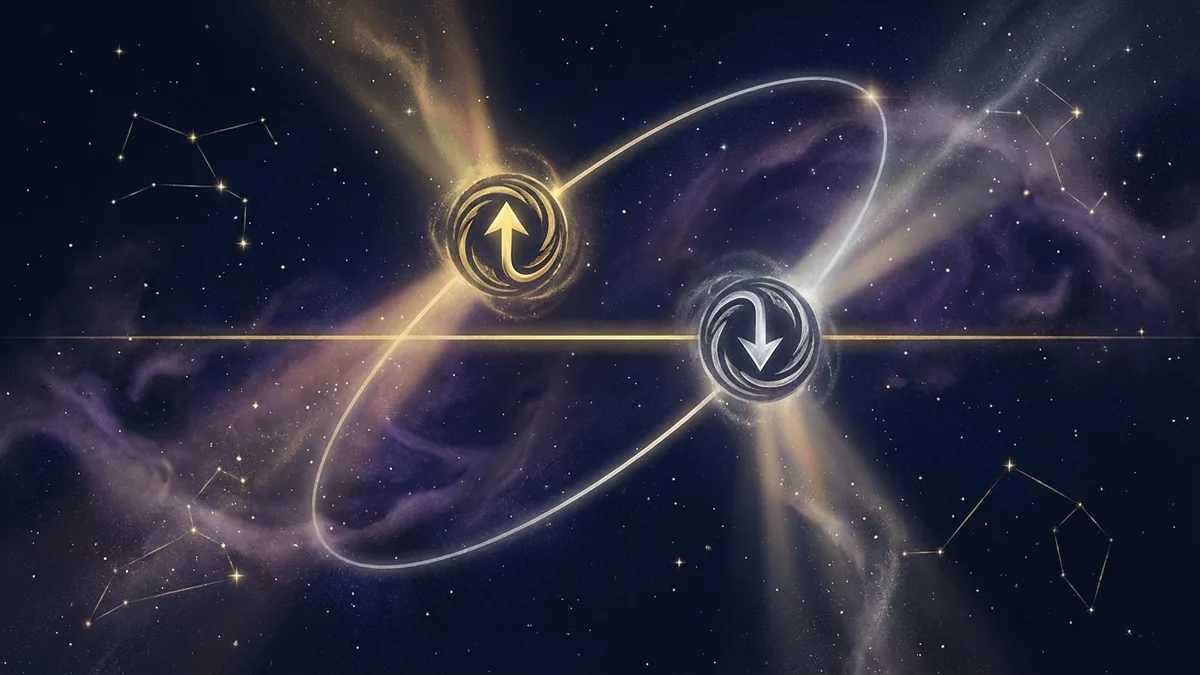
In every birth chart, you'll find two nodes positioned exactly opposite each other. The North Node, also called the ascending node, marks where the Moon crosses the ecliptic moving northward. The South Node, or descending node, sits 180 degrees opposite. Traditional astrology often frames these points through the language of karma and reincarnation—the South Node representing past-life patterns and accumulated skills, the North Node indicating the soul's evolutionary direction in this lifetime. Whether or not you subscribe to reincarnation, this framework offers a powerful metaphor for understanding ingrained patterns versus growth edges.
The nodes matter because they describe a fundamental psychological and spiritual dynamic: the pull between what feels familiar and what calls us forward. The South Node represents territory where we're naturally competent, sometimes to the point of over-reliance. The North Node points toward qualities, experiences, and ways of being that feel awkward or intimidating but hold the key to fulfillment. This axis creates productive tension in the chart, a compass pointing toward meaningful development rather than mere comfort.
How It Works
The lunar nodes move retrograde through the zodiac, taking approximately 18.6 years to complete a full cycle through all twelve signs. This backward motion is fitting symbolically—the South Node particularly asks us to review and integrate rather than simply forge ahead. At any given time, the transiting nodes occupy one pair of opposite signs, creating a collective theme that colors roughly eighteen months before shifting to the next axis. The nodes spend about a year and a half in each sign pair, moving in reverse order through the zodiac.
In your natal chart, the nodes' sign and house placement reveal specific areas of life tension and growth. The South Node's sign describes qualities you've over-developed or rely on instinctively, often to diminishing returns. These are your default settings, the responses that arise automatically under stress. They represent genuine abilities—the South Node isn't about weakness or past-life punishment. Rather, it describes patterns that once served you but now limit your range. The house containing your South Node shows life areas where you might coast, avoid challenge, or repeat familiar patterns without conscious awareness.
The North Node, by contrast, describes qualities that don't come naturally but carry your potential for growth and satisfaction. Its sign reveals traits you need to develop, perspectives you need to adopt, and ways of engaging with life that initially feel foreign or uncomfortable. The house placement shows which life areas require your conscious attention and effort. Moving toward your North Node typically involves risk, awkwardness, and the vulnerability of being a beginner. This discomfort is precisely the point—growth happens at the edge of competence, not in the center of mastery.
The nodal axis operates as a polarity, and like all polarities in astrology, the goal isn't to abandon one end for the other. You don't reject your South Node entirely; you integrate its gifts while consciously developing North Node qualities. Think of it as rebalancing rather than replacement. Someone with a South Node in Libra and North Node in Aries doesn't need to become selfish or dismissive of relationships. They need to bring more self-assertion, independence, and direct action into their relational awareness. The South Node provides the foundation; the North Node provides the growth direction. Together, they create a developmental path that honors both innate gifts and evolutionary potential.
Examples in Action
Consider someone born with the South Node in Cancer in the fourth house and North Node in Capricorn in the tenth house. This person likely has deep instincts around nurturing, emotional sensitivity, and creating safe domestic spaces. They might naturally understand family dynamics, feel others' emotional needs acutely, and default to caretaking roles. In childhood, they may have been the family peacemaker or the one who absorbed everyone's feelings. These are real skills, but over-reliance on them creates problems. This person might struggle to establish professional authority, avoid public visibility, or sacrifice career ambitions for family obligations—even when those obligations aren't truly necessary. The growth path involves developing Capricorn qualities: professional competence, public responsibility, emotional boundaries, and the ability to structure their life around personal ambitions rather than others' emotional needs. This doesn't mean becoming cold or abandoning family; it means bringing more conscious choice to how they balance private and public life.
Another example: someone with South Node in Gemini in the third house and North Node in Sagittarius in the ninth house. This person excels at gathering information, making quick mental connections, and adapting their communication to immediate circumstances. They're often intellectually curious, socially versatile, and skilled at navigating their immediate environment. The shadow side shows up as intellectual restlessness without deeper understanding, a tendency to skim surfaces rather than commit to mastery, or getting lost in details while missing larger patterns. The North Node in Sagittarius calls them toward synthesis rather than collection, toward belief systems and philosophies rather than isolated facts, toward teaching and wisdom rather than mere information exchange. They might need to travel, pursue higher education, engage with foreign cultures, or develop expertise in a field that requires sustained focus. The challenge involves tolerating the discomfort of not knowing everything, committing to a perspective even while remaining open to growth, and trusting that depth matters more than breadth.
The transiting nodes also create meaningful cycles. When the transiting North Node conjoins your natal Sun, for instance, you often experience a period where your core identity aligns with collective evolutionary themes. Opportunities emerge that feel simultaneously fated and aligned with your authentic self-expression. When the transiting South Node crosses your natal Venus, you might revisit old relationship patterns, reconnect with past lovers, or find yourself falling into familiar but ultimately unsatisfying dynamics around love and values. These transits, occurring roughly every nine years at each natal planet, provide checkpoints for assessing growth along your nodal axis.